The AI Monster we built

The popular fear is simple: AI will destroy us.

It’s the version that dominates headlines and, honestly, shaped the collective psyche of anyone raised on late 20th-century blockbusters. We have been conditioned to wait for the rupture. That specific cinematic moment when the machines turn against their creators and everything collapses in a hail of chrome and red eyes. And today, with AI Agents managing our lives and LLMs our thoughts, that fear is more alive than ever.
When we first rewatched The Animatrix (2003), we wondered: why does AI in cinema almost always end in dystopia? So we started looking into the different eras of the 'AI monster', expecting more stories of annihilation by the machines. But something else emerged. Beneath all the spectacle, the violence and the collapse of humanity, runs a quieter fear. Another kind of dystopia.
And it is not a fear of what the technology will do to us, but of how it will be used to replace us.
‘JE EST UN MONSTRE’
If we look at monsters through the anthropological lens of Marc Atallah and his book La Parade Monstrueuse (“The monstrous parade”), the premise is simple: the monsters in our stories are a direct reflection of our own violence, greed and ego.
“Monsters and metaphors seem united by a common destiny: the capacity to describe the same, the norm and the 'here' differently, through an impertinence, a dissimilarity born of an ontological elsewhere”, Marc Atallah
In other words, each monster informs us about the world it is birthed from and what it means to be human in that specific moment.

Godzilla | ©Toho 
Godzilla poster
In the nineteenth century, for example, the figure of the Mad Scientist rises alongside rapid advances in science (medicine, astronomy, mathematics, etc.), reflecting both fascination and fear toward human knowledge pushing its own limits. In 1954, Godzilla emerges as a direct response to nuclear anxiety and our relationship with atomic technology.
SAME FEAR. A CENTURY LATER. AI MONSTER
Strictly speaking, Metropolis (1927) isn’t about a sentient AI. The machine, called False Maria, does not think or decide. Yet, she represents the most prophetic proto-deepfake in cinema history. The scientist Rotwang initially builds her to replace his deceased love, Hel.
But when the master of the city sees the machine, he realizes its potential for mass manipulation. He steals the likeness of the living Maria (who guides the people) and maps her face onto the steel. He chooses the machine because the real Maria has a conscience and a conscience is, well, inefficient.

Metropolis 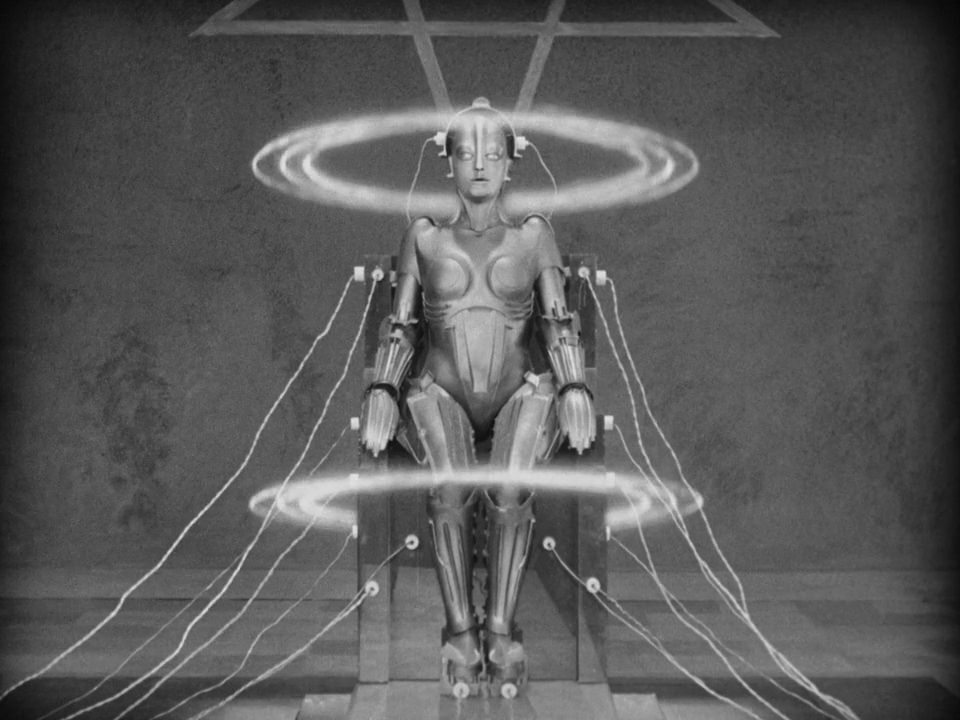
Metropolis
This feels strangely familiar in 2026 (the exact year Metropolis is set). While in 1927 they used chemical baths and electricity to harvest a likeness, today we use training sets and pixels. This is what we now call digital necromancy. In a way, Fake Maria embodies the moment we discover that our own image (the very thing that makes us "us") can be detached, duplicated and used against us.
“Metropolis provides not only one of the earliest examples of evil AI, but also one of the earliest evil AI researchers, in the form of mad scientist Rotwang”, USC (Institute for Creative Technologies).
In the Black Mirror episode Joan Is Awful (2023), we see the modern evolution of this experiment. Joan’s entire life is harvested by an algorithm to create a simulated version of her reality for mass consumption. But it's not the AI doing all these things.. No. It's the corporate greed behind it that turns a human life into owned content.
And cinema has been refining this concept for over a century. From the men of The Stepford Wives (1975) replacing their partners with compliant doubles, to the corporation in RoboCop (1987) harvesting a dying man to build a more efficient product, the message is clear: the threat isn't really the machine’s will, but the system's preference for a more profitable, less complicated version of humanity.
This is exactly what Scarlett Johansson echoed when she spoke out about OpenAI using a voice that sounded like hers after she had already declined the offer:
“I was shocked, angered and in disbelief that Mr. Altman would pursue a voice that sounded so eerily similar to mine that my closest friends and news outlets could not tell the difference”, Scarlett Johansson to NPR.
THE MIRROR'S CHOICE
If we return to the lens of Marc Atallah, we have to ask: what is this mirror actually showing us? Is the 'AI monster' a metaphor for the economic and social system that has spent a century reducing human beings to variables: measured, optimized and, when possible, replaced? Or does it reveal a more fundamental obsession: our need to control and eliminate uncertainty?
Because, replacing the human is not the goal. Control is.
And perhaps that’s where the fear of annihilation comes from. Because in trying to control everything, we inevitably build systems that no longer need us.
The question that remains now is: is there another side of the mirror? What about utopias?


Comments